A PPO, short for Preferred Provider Organization, is a type of health insurance plan built around a network of preferred doctors and hospitals. You pay less when you use providers inside that network, but the plan still covers care from providers outside it, just at a higher cost. The feature most people care about is flexibility: a PPO lets you see specialists without a referral and does not require you to pick a primary care doctor.
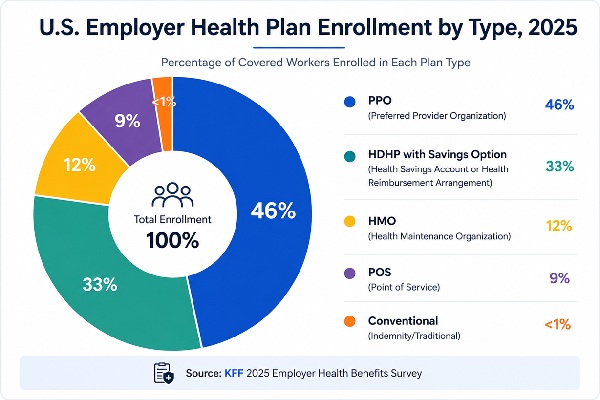
In plain terms, a PPO trades a higher monthly premium for more freedom and fewer rules. It is the most common type of employer health plan in the country. According to the KFF 2025 Employer Health Benefits Survey, 46 percent of covered workers are enrolled in a PPO, more than any other plan type. If you want broad access to providers and dislike the gatekeeping of stricter plans, a PPO is usually the option that fits.
PPO Health Plan at a Glance
Feature
Details
Full name
Preferred Provider Organization
Plan type
Managed care health insurance
Provider network
Large, with preferred in-network rates
Referral required
No
Primary care doctor required
No
Out-of-network coverage
Yes, at a higher cost
Typical premium
Higher than average
Best for
Flexibility, specialist access, travel
Common alternatives
HMO, EPO, POS, HDHP
Enrollment rank
Most common employer plan type
How Does a PPO Work?
A PPO sorts providers into two groups, and which one you use decides what you pay. In-network providers have agreed to discounted rates with your insurer, so your share is lower. Out-of-network providers have no such agreement, so you pay more, and sometimes the difference is large.
The second defining trait is freedom of movement. You do not need to choose a primary care physician, and you do not need a referral to see a specialist. If you want to book a dermatologist or a cardiologist directly, you can.
Care choice
What it means for you
In-network provider
Lowest cost, discounted rates
Out-of-network provider
Covered, but you pay a larger share
Seeing a specialist
No referral needed
Primary care doctor
Optional, not required
This structure is why PPOs appeal to people who value control. The plan rarely tells you who to see or when, which is a meaningful difference from tighter plan types.
How Common Are PPOs?
PPOs are not a niche option. They lead the market for employer-sponsored coverage by a wide margin, which is part of why the term shows up on so many benefit menus.
U.S. Employer Health Plan Enrollment by Type, 2025
The takeaway is simple. Nearly half of covered workers are in a PPO, while high-deductible plans come second and HMOs trail behind. When people talk about a “standard” workplace health plan, they are often picturing a PPO.
What a PPO Costs
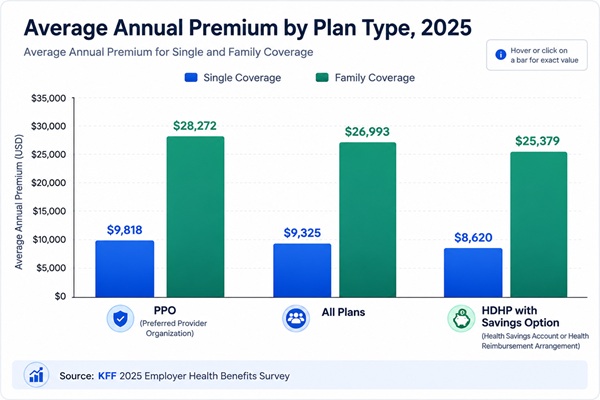
A PPO usually carries a higher premium than other plan types, and the survey data backs that up. The KFF 2025 survey put the average PPO premium at $9,818 for single coverage and $28,272 for family coverage, both above the all-plan averages of $9,325 and $26,993.
Premiums are only one piece. Your real spending depends on several moving parts.
Cost type
What it is
Premium
The fixed amount you pay each month for coverage
Deductible
What you pay before the plan starts sharing costs
Copay
A flat fee for a visit or service
Coinsurance
Your percentage share after the deductible
Out-of-pocket maximum
The yearly cap on what you pay
The out-of-network factor deserves a flag. Care outside the network often comes with a separate, higher deductible and a larger coinsurance share, and some providers may bill you for the gap between their charge and what the plan allows. Staying in-network keeps costs predictable.
PPO vs HMO: What Is the Difference?
This is the comparison most people are weighing, because PPOs and HMOs sit at opposite ends of the flexibility scale. An HMO keeps costs down by tightening the rules, while a PPO loosens the rules in exchange for a higher price.
Feature
PPO
HMO
Premium
Higher
Lower
Provider network
Large
Smaller
Out-of-network care
Covered at higher cost
Generally not covered
Primary care doctor
Not required
Required
Referral for specialists
Not needed
Needed
Best fit
Flexibility seekers
Budget-focused patients
If you rarely leave your area, do not mind a referral step, and want the lowest premium, an HMO can be a smart pick. If you travel, see specialists often, or want to keep a specific doctor who may be out of network, a PPO earns its higher cost.
PPO vs EPO vs POS
Two other plan types blend features from both sides, so it helps to see where they land.
Plan
Out-of-network coverage
Referral needed
PPO
Yes
No
EPO
No
Usually no
POS
Yes
Usually yes
An EPO behaves like an HMO on networks but skips the referral requirement. A POS plan flips that, allowing out-of-network care like a PPO while still asking for a primary care doctor and referrals. A PPO remains the most open of the four.
Who Is a PPO Health Plan Best For?
A PPO suits people whose care does not fit a tidy box. If any of these describe you, the flexibility tends to pay off.
You see specialists regularly and want to skip the referral process.
You travel often or split time between cities and need providers in more than one place.
You have a doctor you want to keep, even if they fall outside the network.
You prefer making your own care decisions without a gatekeeper.
A PPO is a weaker fit if your main goal is the lowest possible premium and you are comfortable staying inside a set network. In that case, an HMO or a high-deductible plan may serve you better.
Pros and Cons of PPO Plans
No plan is all upside. Weighing both sides helps you decide if the tradeoff makes sense for your situation.
Pros
Cons
No referrals to see specialists
Higher monthly premiums
Out-of-network care is covered
Out-of-network costs add up fast
Large provider networks
Can mean more paperwork
No primary care doctor required
More complex cost structure
Good for travel and specialist care
Often not the cheapest choice
PPO Plans in Oregon
For Oregon residents, PPOs turn up most often in employer-sponsored coverage, where they remain a popular default. Major insurers in the state offer PPO options through workplace benefits, and the flexibility is a common reason employees choose them.
On the individual market, the picture varies. Plan types available through the Oregon Health Insurance Marketplace differ by insurer and region, and many individual plans are structured as HMOs or EPOs rather than PPOs. The practical step is to check the plan type label before you enroll, since the letters next to a plan name tell you how much freedom you are buying.
How to Decide If a PPO Is Right for You
A few questions cut through the noise and point you toward the right plan.
How often do you see specialists, and do you want to avoid referrals?
Are your preferred doctors in the plan’s network?
Do you travel enough to need out-of-area coverage?
Can your budget absorb a higher premium for that flexibility?
Would a lower-premium plan with a tighter network actually meet your needs?
If your answers lean toward flexibility and specialist access, a PPO is likely your match. If they lean toward saving money and you are fine with a set network, a different plan type may win.
Frequently Asked Questions
What does PPO stand for?
PPO stands for Preferred Provider Organization, a plan built around a network of preferred providers with optional out-of-network coverage.
Do I need a referral with a PPO?
No. You can see specialists directly without a referral, and you are not required to pick a primary care doctor.
Is a PPO more expensive than an HMO?
Usually yes. PPOs tend to carry higher premiums in exchange for greater flexibility and broader network access.
Does a PPO cover out-of-network care?
Yes, but at a higher cost. You typically face a larger deductible and coinsurance share for out-of-network providers.
Why are PPOs so common?
They balance choice and coverage in a way many people prefer, which is why they remain the most common employer plan type.
Can I get a PPO on the individual market?
Sometimes. Availability depends on the insurer and your region, so check the plan type label before enrolling.
Laboratory research often examines biological compounds through carefully planned cellular studies. Peptides can support investigations that focus on tissue structure and cellular activity. Researchers can examine specific biological interactions through controlled laboratory models, allowing observations to remain focused and measurable. This approach helps organize research...