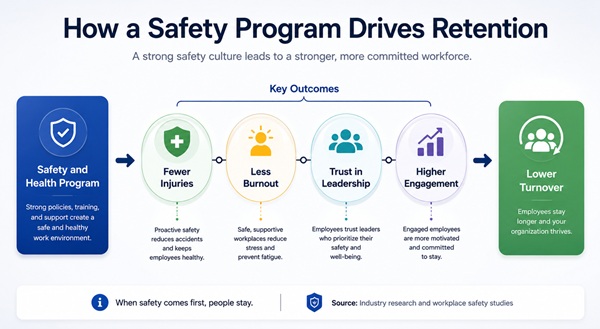
A well-implemented safety and health program improves employee retention. When a workplace actively protects people from harm, employees are less likely to get hurt, less likely to burn out, and more likely to trust the people leading them. That combination of physical safety, mental wellbeing, and trust is exactly what keeps good workers from leaving.
The effect is not magic, and it is not a single lever. A strong program lowers injuries and the stress that comes with an unsafe environment, signals that leadership genuinely cares, and lifts daily engagement. Each of those reduces the reasons people quit. The sections below break down how the connection works, what the evidence supports, and what a program needs to actually deliver these results.
The Link at a Glance
Question
Answer
Does a safety program improve retention?
Yes, when it is well implemented and not just on paper
Main mechanisms
Fewer injuries, less burnout, more trust, higher engagement
Who it affects most
Frontline and higher-risk roles, but all employees benefit
Business payoff
Lower turnover costs, fewer claims, more stable teams
What makes it work
Leadership commitment, training, and employee involvement
Bottom line
Safety is a retention strategy, not just a compliance task
The Short Version
The relationship follows a simple chain. A real safety program makes the workplace safer and healthier, that protection builds trust and engagement, and trust and engagement are what make people stay.
Step
What happens
Safety program in place
Hazards are managed, training is real, concerns are heard
Employees feel protected
Fewer injuries, less stress, more confidence at work
Trust and engagement rise
People see that leadership values them
Retention improves
Employees choose to stay rather than look elsewhere
How a Safety Program Drives Retention
Fewer Injuries and Less Burnout
The most direct effect is the obvious one. People who do not get hurt stay able to work, and they stay willing to work. An injury can end a tenure outright, but even near misses and a constant sense of risk wear people down over time.
Burnout matters just as much as physical injury. A program that addresses workload, fatigue, and mental health protects employees from the exhaustion that quietly pushes them toward the exit. Health and safety, taken together, keep both the body and the mind in a state where staying is possible.
The Leadership Cares Signal
Safety sends a message that goes beyond the hazard it prevents. When employees see a company invest real effort in protecting them, they read it as a sign of competent, caring leadership. The unspoken message is that the organization has things under control and values the people doing the work.
That perception builds loyalty in a way perks cannot. A foosball table is nice, but it does not tell an employee that their wellbeing matters. A serious safety program does, every single day, and that sense of being valued is a powerful reason to stay.
Engagement and Morale
Employees who feel safe and supported show up differently. They tend to have more energy and focus, they disengage less often, and they are less likely to scan job boards on their lunch break. Engagement and retention move together, and safety is one of the foundations engagement is built on.
The reverse is also true. In a workplace where people feel exposed or ignored, morale erodes, and disengaged employees are the ones most likely to leave first. A safety program protects against that slow drain.
Cost and Stability
Turnover is expensive in ways that are easy to underestimate. Replacing a worker means recruiting, hiring, and training costs, plus the lost productivity while a new person gets up to speed. Add the knowledge that walks out the door with an experienced employee, and the bill grows further.
A strong safety program chips away at all of it.
Fewer injuries mean lower workers’ compensation premiums and medical costs.
Lower turnover means less spent on constant recruiting and onboarding.
Experienced staff stay, keeping hard-won knowledge inside the company.
Stable teams run more smoothly and avoid the instability that breeds more incidents.
The stability is self-reinforcing. Constant churn opens the door to more mistakes, which can cost more than the money a company tried to save by running lean.
What Does the Research Actually Say?
The honest answer is that the direction of the relationship is well supported, even if you should be skeptical of some of the numbers floating around online. A peer-reviewed 2025 study in the Future Business Journal found that occupational health and safety practices had a significant relationship with turnover intention through organizational commitment. In plain terms, safety practices build commitment, and committed employees are less likely to want to leave.
The scale of the underlying problem is real too. The International Labour Organization has reported roughly 2.3 million deaths a year from work-related accidents or illnesses, alongside hundreds of millions of non-fatal occupational injuries. Against that backdrop, safety is not a minor workplace nicety.
There is also a striking finding on quitting itself. According to the Work Institute, 78 percent of employees said their resignation could have been prevented by the employer, which points to how much retention sits within a company’s control, including through how seriously it takes safety and employee concerns.
One caution worth stating plainly. Some articles on this topic claim very specific boosts, such as raising retention by a set high percentage, and trace those figures back to vague, unnamed studies. Treat precise claims like that carefully. The well-supported takeaway is the relationship and its mechanisms, not a single magic number.
What a Well-Implemented Program Looks Like
The phrase well-implemented is doing a lot of work in this question. A safety policy that exists only in a binder will not move retention. The programs that do share a few traits.
Element
Why it matters for retention
Leadership commitment
Employees believe safety is real only when leaders model it
Hazard identification
Finding and fixing risks before they cause harm
Genuine training
People feel competent and protected, not just lectured
Employee involvement
Workers who help shape safety feel ownership and respect
Following through on concerns
Acting on feedback proves the company is listening
Continuous improvement
A living program signals ongoing care, not a one-time box
The thread running through all of these is credibility. Employees can tell the difference between a company that walks the talk and one that posts a poster and moves on.
Safety, Oregon OSHA, and Central Oregon Employers
For employers in Bend and across Central Oregon, this topic carries a local dimension. Oregon operates its own state workplace safety program through Oregon OSHA, which sets and enforces occupational safety and health standards for employers in the state. Aligning a safety program with those requirements is the baseline.
The retention benefit, though, comes from going past the baseline. Meeting the minimum keeps a business compliant, but the trust and loyalty that reduce turnover come from treating safety as a value rather than a rule to satisfy. For local industries with physical risk, from construction to hospitality to healthcare, that distinction can be the difference between a revolving door and a stable, experienced team.
Mistakes That Undercut Retention
Even well-meaning programs can fail to deliver if they fall into a few common traps.
Treating safety as a compliance checkbox rather than a genuine priority.
Collecting employee concerns and then doing nothing about them.
Focusing only on physical hazards while ignoring burnout and mental health.
Rolling out rules without training or explanation.
Letting leadership exempt itself from the standards everyone else follows.
Each of these sends the opposite of the caring signal, and employees notice quickly when a program is hollow.
Frequently Asked Questions
Does a safety program really reduce employee turnover?
Yes. By cutting injuries and burnout, building trust in leadership, and raising engagement, a well-run safety program removes several of the main reasons people quit.
Why does safety affect whether people stay?
Because it signals that the company values its workers. That sense of being protected and respected builds the loyalty that keeps employees from leaving.
Is this just about physical injuries?
No. Mental health and burnout play an equally large role. A program that ignores workload and stress misses a major driver of turnover.
What makes a safety program well-implemented?
Real leadership commitment, hazard control, genuine training, employee involvement, and follow-through on concerns. A policy that only exists on paper will not move retention.
How does this save a business money?
Through lower workers’ compensation costs, fewer medical claims, and far lower turnover expenses, plus the value of keeping experienced staff and their knowledge.
What does this mean for Oregon employers?
Oregon employers operate under Oregon OSHA standards. Meeting those is the baseline, but the retention payoff comes from treating safety as a genuine value, not just a requirement.
Laboratory research often examines biological compounds through carefully planned cellular studies. Peptides can support investigations that focus on tissue structure and cellular activity. Researchers can examine specific biological interactions through controlled laboratory models, allowing observations to remain focused and measurable. This approach helps organize research...