
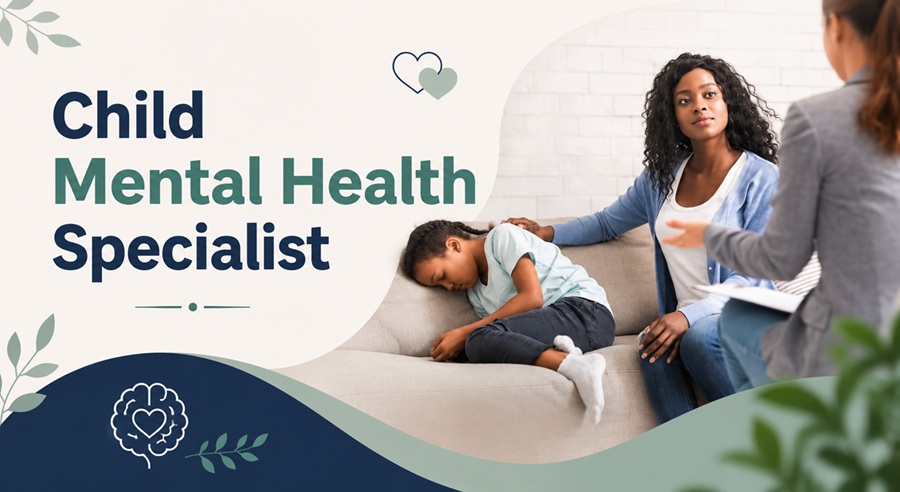

A child mental health specialist is a trained professional who assesses and treats emotional, behavioral, and developmental concerns in children and teens. The phrase is an umbrella term rather than a single job title. It covers several kinds of providers, including child psychiatrists, child psychologists, and licensed therapists, each with different training and a different role in your child’s care.
Which one your child needs depends on the concern. A therapist is often the right starting point for anxiety, sadness, or behavioral struggles. A psychologist adds in-depth testing and assessment. A child psychiatrist, who is a medical doctor, comes in when a condition may benefit from medication. Many children do best with a team, and the sections below explain who does what, the signs that it may be time to reach out, and how to find help in Bend and across Central Oregon.
Types of Specialists at a Glance
| Detail | Summary |
|---|---|
| What it is | An umbrella term for providers who treat children’s mental health |
| Common types | Child psychiatrist, psychologist, therapist or counselor |
| Who can prescribe | Psychiatrists and some nurse practitioners or physician assistants |
| Who does testing | Psychologists and neuropsychologists |
| Best first step | Talk with your child’s pediatrician or school counselor |
| Team approach | Many kids see both a therapist and a psychiatrist |
| When it’s urgent | Talk of self-harm or immediate danger needs emergency help |
What Is a Child Mental Health Specialist?
A child mental health specialist focuses on the emotional and behavioral wellbeing of young people, from early childhood through the teenage years. These providers are trained to recognize how a child’s development, family, and environment shape mental health, which is different from treating an adult.
The reason the term is broad is that no single professional does everything. One may run psychological tests, another prescribes and monitors medication, and another meets weekly for talk therapy. Understanding the differences helps you find the right fit faster, and the right fit matters. The trust and comfort a child feels with their provider is one of the strongest predictors of whether treatment helps.
The Main Types of Child Mental Health Specialists
Several kinds of professionals work with children, and their training and abilities vary.
| Specialist | Training | Main role | Prescribes? |
|---|---|---|---|
| Child and adolescent psychiatrist | Medical doctor (MD or DO) with psychiatry residency and child fellowship | Diagnoses, manages medication, treats complex conditions | Yes |
| Child psychologist | Doctoral degree (PhD or PsyD) | Therapy plus in-depth testing and assessment | No |
| Therapist or counselor | Master’s degree (LCSW, LPC, or LMFT) | Talk therapy for emotional and behavioral concerns | No |
| Developmental-behavioral pediatrician | Medical doctor with extra training | Evaluates developmental and behavioral concerns | Yes |
| Psychiatric nurse practitioner or PA | Advanced practice training | Evaluation and medication, often with a psychiatrist | Yes |
| Neuropsychologist | Doctoral degree | Tests brain function, learning, and attention | No |
| School psychologist or counselor | Master’s or doctoral degree | Support and assessment within the school setting | No |
A pediatrician is often the very first contact. They can screen for concerns and refer your child to the right specialist, which is why starting there is usually the simplest path.
Child Psychiatrist vs Psychologist vs Therapist: What Is the Difference?
This is the question most parents have, and the short version comes down to three things: medication, testing, and talk therapy.
A therapist provides talk therapy. They are a strong choice for situational struggles or mild to moderate anxiety, sadness, or behavior issues, using approaches like cognitive behavioral therapy and play therapy. A psychologist also provides therapy but adds detailed psychological testing, which is valuable when you need a fuller picture or suspect a learning difference, ADHD, or autism. A child psychiatrist is a medical doctor who can diagnose conditions and prescribe medication, and is usually involved when symptoms are more severe or when medication may help.
These roles often overlap and complement each other. A common and effective setup is a child seeing a therapist for weekly sessions while a psychiatrist manages medication, so both the day-to-day skills and the medical side are covered.

What Are the Signs My Child May Need a Specialist?
Every child has hard days, so the question is about patterns rather than single moments. It may be time to reach out when changes last for weeks, get in the way of daily life, or cause real distress.
Common signs include:
- Ongoing sadness, worry, or irritability that does not lift
- Withdrawing from friends, family, or activities they used to enjoy
- Sudden drops in grades or trouble functioning at school
- Big changes in sleep, appetite, or energy
- Frequent anger, aggression, or defiance beyond the usual
- Physical complaints like headaches or stomachaches with no clear cause
- Returning fears, nightmares, or anxiety that disrupts the day
You do not need to wait for a crisis to seek an evaluation. Reaching out early often leads to better outcomes and helps a child feel supported rather than singled out.
One exception calls for immediate action. If your child talks about suicide or self-harm, or you believe they are in immediate danger, treat it as an emergency. Call 911, go to the nearest emergency room, or use the crisis resources listed below right away.
What to Expect From Care
The first visit is usually an evaluation. The provider talks with you and your child, gathers history, and may use questionnaires to understand what is going on. From there, they suggest a plan, which might be therapy, testing, medication, or a combination.
Care is often collaborative. Specialists frequently coordinate with each other, with your pediatrician, and with the school, so everyone supports your child in the same direction. Finding the right provider can take a little patience, and it is completely reasonable to ask about a professional’s training and experience with your child’s specific concern.
How to Find a Child Mental Health Specialist
The search feels less daunting when you break it into steps.
- Start with your child’s pediatrician or school counselor, who can screen and refer.
- Ask your health insurer for a list of covered child mental health providers.
- Check professional directories, which let you filter by the ages a provider serves and their area of expertise.
- Look into community mental health programs, which serve families regardless of ability to pay.
When you contact a provider, it is fine to ask whether they are accepting new patients, what conditions they focus on, and whether they work with children of your child’s age.
Finding Support in Bend and Central Oregon
Families in the Bend area have several local paths to care. Your child’s pediatrician is a good first call for a referral. St. Charles offers behavioral health services, and local medical groups in the region include psychiatry and counseling among their specialties.
Deschutes County Behavioral Health provides mental health services to youth and families, including some delivered through local schools. For families who need lower-cost options, community and county programs are designed to help regardless of insurance status. School-based health clinics across Bend, Redmond, La Pine, and Sisters can also be a starting point during the school year.
Crisis and Support Resources
If your child is struggling now, help is available at any hour. For an immediate emergency, call 911 or go to the nearest emergency room.
| Resource | Contact |
|---|---|
| 988 Suicide and Crisis Lifeline | Call or text 988 |
| Oregon YouthLine (teen to teen) | 877-968-8491, or text teen2teen to 839863 |
| Deschutes County 24-hour Crisis Line | 541-322-7500, ext. 9 |
| Deschutes County Stabilization Center | Walk in at 63311 NE Jamison Street, Bend, open 24/7 |
| St. Charles Behavioral Health Services | 541-706-2768 |
| The Trevor Project (LGBTQ+ youth) | 1-866-488-7386, or text START to 678678 |
Oregon YouthLine is staffed by trained teens daily from 4 to 10 p.m., with adults answering at other hours, which can make it feel more approachable for a young person. The Stabilization Center in Bend welcomes walk-ins during a mental health crisis and serves both children and adults.
Helping Your Child Feel Okay About Getting Help
How you frame the visit shapes how your child feels about it. Seeing a specialist is not a punishment or a sign that something is wrong with them, and saying so plainly helps. Many parents find it useful to compare it to seeing a doctor for any other part of health.
Let your child know it is a space to talk, learn skills, and feel better, and that lots of kids do it. Your steadiness and support matter as much as the specialist you choose, since feeling understood at home makes the work in therapy stick.
Frequently Asked Questions
What does a child mental health specialist do?
They assess and treat emotional, behavioral, and developmental concerns in children and teens. Depending on their training, that can mean talk therapy, psychological testing, or medication management.
Should I take my child to a psychologist or a psychiatrist?
A psychologist is often best for therapy and testing, while a psychiatrist is the right choice when medication may help or symptoms are severe. Your pediatrician can help you decide where to start.
At what age can a child see a mental health specialist?
Specialists work with children of all ages, from early childhood through the teen years. If you notice persistent concerns at any age, an evaluation is appropriate.
How do I know if it is just a phase?
Look at duration and impact. If difficulties last for weeks, interfere with school, friendships, or home life, or cause real distress, it is worth seeking professional input.
Can a child see both a therapist and a psychiatrist?
Yes, and this team approach is common. The therapist handles regular sessions and skill-building while the psychiatrist manages any medication.
Where can I find help quickly in Central Oregon?
Start with your pediatrician for a referral, or contact Deschutes County Behavioral Health. In a crisis, call or text 988, or use the local crisis line at 541-322-7500, ext. 9.