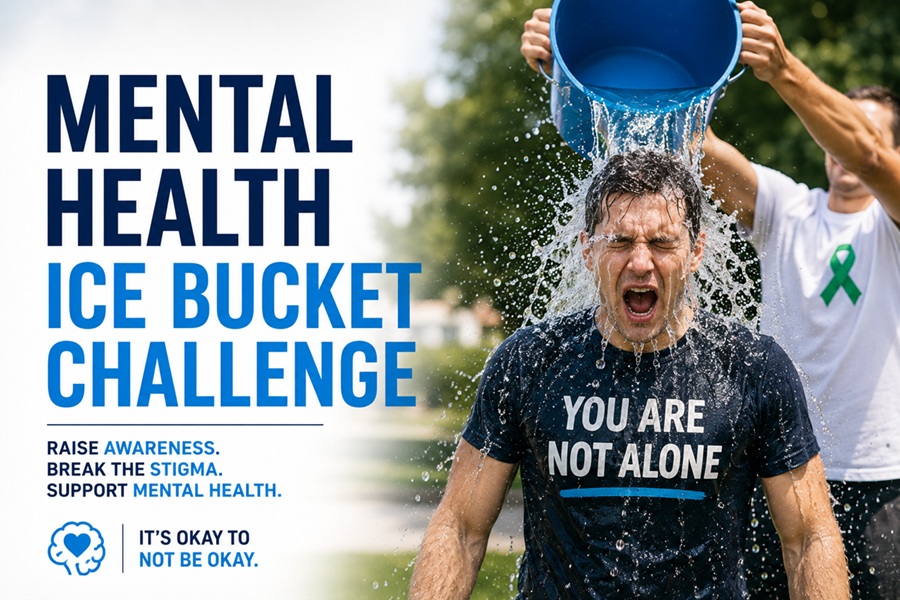

The mental health ice bucket challenge is a viral campaign, officially called the #SpeakYourMIND Ice Bucket Challenge, that reimagined the famous 2014 trend to raise awareness and money for mental health. It was started by the MIND club, short for Mental Illness Needs Discussion, at the University of South Carolina. Participants dump a bucket of ice water over their heads, nominate others to do the same, and donate to the nonprofit Active Minds.
The campaign first exploded across social media in spring 2025, and its momentum has carried into 2026, where it continues to resurface around Mental Health Awareness Month each May. What began as a student idea with a goal of a few hundred dollars grew into a national movement that has raised well over $400,000 for Active Minds and drawn in athletes, actors, and hundreds of thousands of everyday participants. Here is the full story, where it stands in 2026, and how to take part in a way that actually helps.
The Challenge at a Glance
| Detail | Summary |
|---|---|
| Official name | #SpeakYourMIND Ice Bucket Challenge |
| Started by | USC’s MIND club (Mental Illness Needs Discussion) |
| Founder | Wade Jefferson, USC student |
| Launched | March 31, 2025, on Instagram |
| Status in 2026 | Ongoing, revived around Mental Health Awareness Month |
| Cause | Mental health awareness |
| Benefits | Active Minds nonprofit |
| Raised | More than $400,000, nearing its $500,000 goal |
What Is the Mental Health Ice Bucket Challenge?
The challenge is a social media movement built to normalize conversations about mental health. It launched on March 31, 2025, when the MIND club at the University of South Carolina posted its first video on Instagram, reimagining the viral ice bucket format for a new cause.
The club’s founder, Wade Jefferson, started MIND after losing two friends to suicide, and the group centers on three goals: breaking the stigma around mental health, advocating for suicide prevention on campus, and practicing daily mindfulness. As Jefferson put it, conversations about mental health should feel as common and comfortable as conversations about physical health. The campaign paired that mission with donations to Active Minds, the largest nonprofit in the country mobilizing young people to change how mental health is viewed.
How the Challenge Works
The format is simple and familiar, which is part of why it spread so fast. Anyone can take part in a few steps.
- Film yourself pouring a bucket of ice water over your head.
- Share the video on social media using the hashtag #SpeakYourMIND.
- Nominate friends or family to do the same, traditionally within 24 hours.
- Donate to Active Minds, or include a link so others can.
- Say a few words about mental health to give the moment real meaning.
That last step matters most. The dunk grabs attention, but the message and the donation are what turn a fun clip into genuine advocacy.
How It Went Viral
Jefferson originally set a goal of around $500 and expected the challenge to stay on the USC campus. Instead, it took off nationally within days, a scale the students found surreal.
Momentum built as high-profile names joined in. Former NFL quarterback Peyton Manning and receiver Emmanuel Sanders participated, and Jenna Bush Hager completed the challenge on NBC’s Today, nominating fellow hosts. As the trend carried on, the list of participants widened to include actor Scarlett Johansson, digital creator Zach King, beauty influencer James Charles, and a segment on The Tonight Show with Jimmy Fallon. The @uscmind Instagram account swelled past 700,000 followers, and the launch video drew well over a million views, with people taking part from South Carolina to Denmark.
Where It Stands in 2026
Rather than fading after its 2025 peak, the campaign has settled into an ongoing awareness effort. Its fundraiser for Active Minds remained active into 2026, and as of April 2026 it had raised roughly $439,000 toward a $500,000 goal, making it one of the most successful youth-led mental health campaigns in recent memory.
The movement also expanded beyond a single event. Active Minds and the ALS Association announced a collaboration for May, which is both Mental Health Awareness Month and ALS Awareness Month, using the shared history of the challenge to spotlight that ALS affects people emotionally as well as physically. Similar ice bucket efforts for mental health have appeared internationally too, including one run by the UK charity Mind. The through line in 2026 is that the challenge has become a recurring rallying point rather than a one-time trend.
How It Compares to the 2014 ALS Ice Bucket Challenge
The campaign is a direct callback to one of the most successful viral movements ever. The comparison below shows how the two relate.
Two Ice Bucket Challenges, Two Causes
Click for more →
2014 ALS Ice Bucket Challenge
Origin:
Pete Frates
Pat Quinn
Anthony Senerchia
The campaign became a global viral movement and raised approximately $115 million for ALS research.
Click for more →
2025 Mental Health Ice Bucket Challenge
Origin:
USC MIND Club
Wade Jefferson
The challenge revived the spirit of the original campaign while focusing on mental health awareness and supporting Active Minds.
Importantly, the original creators gave their blessing. The ALS Association said it was thrilled to see the spirit of its challenge live on, which helped the revival feel like a continuation rather than a competition.
Why It Matters
Beyond the fundraising, the challenge put mental health in front of millions of people during a genuine crisis. According to the National Alliance on Mental Illness, more than one in five U.S. adults live with a mental illness, and campaigns like this help chip away at the stigma that keeps people from seeking help.
The movement also reflects the power of young people to drive change. For many students, seeing peers, teachers, and celebrities speak openly about mental health made the topic feel more approachable and less isolating. That normalization is the quiet, lasting win underneath the viral videos.
The Criticism: When Awareness Turns Performative
An honest look at the challenge includes its critics. Some observers noted that many participants dumped water and nominated friends without ever mentioning mental health or linking to a way to donate, which turns advocacy into a performance about views and likes.
There was also a thoughtful concern about the format. Because the challenge spreads through nominating people in your social circle, those who are already isolated, exactly the people advocates most want to reach, can be left out, which could feel painful rather than supportive. None of this erases the good the campaign did, but it is a reminder that the message matters more than the splash.
A Quick Safety Note
Because this is a physical stunt, a small caution is worth adding. The shock of ice-cold water can trigger a strong physical response, so it is not advised for people with conditions like high blood pressure or a history of heart or cerebrovascular problems. If that applies to you, support the cause by donating or sharing rather than taking the plunge.
How to Take Part Meaningfully
If you want to join in, a few small choices make your participation count.
- Actually talk about mental health in your video, even just a sentence.
- Include a real link to donate to Active Minds.
- Check in personally with the people you nominate, and anyone who seems left out.
- Share a resource so viewers who are struggling know where to turn.
Mental Health Resources
This is a sensitive topic, and awareness campaigns are most valuable when they connect people to real help. If you or someone you know is struggling, support is available at any time. You can call or text 988, the Suicide and Crisis Lifeline, text BRAVE to 741741 to reach the Crisis Text Line, or contact the Trevor Project at 866-488-7386 for LGBTQ+ young people. For finding ongoing care, our guide to finding a child mental health specialist walks through the options. Reaching out is a sign of strength, not weakness.
Frequently Asked Questions
What is the mental health ice bucket challenge?
It is the #SpeakYourMIND Ice Bucket Challenge, started by USC’s MIND club in 2025, which revived the viral trend to raise awareness and funds for mental health through the nonprofit Active Minds.
Is the challenge still happening in 2026?
Yes, in the sense that the campaign and its fundraiser continued into 2026 and tend to resurface around Mental Health Awareness Month each May, though its biggest viral wave was in spring 2025.
Who started it?
Wade Jefferson, a University of South Carolina student who founded the MIND club after losing two friends to suicide, launched it with a first video on March 31, 2025.
How is it different from the ALS ice bucket challenge?
The format is the same, but the cause is different. The 2014 version raised money for ALS research, while this version supports mental health awareness and Active Minds.
How much money has it raised?
More than $400,000 for Active Minds, nearing its $500,000 goal as of 2026, after starting with a modest goal of just a few hundred dollars.
How do I participate safely?
Pour ice water over your head, post it with #SpeakYourMIND, nominate others, and donate. Skip the plunge if you have heart or blood pressure conditions, and support the cause another way instead.