
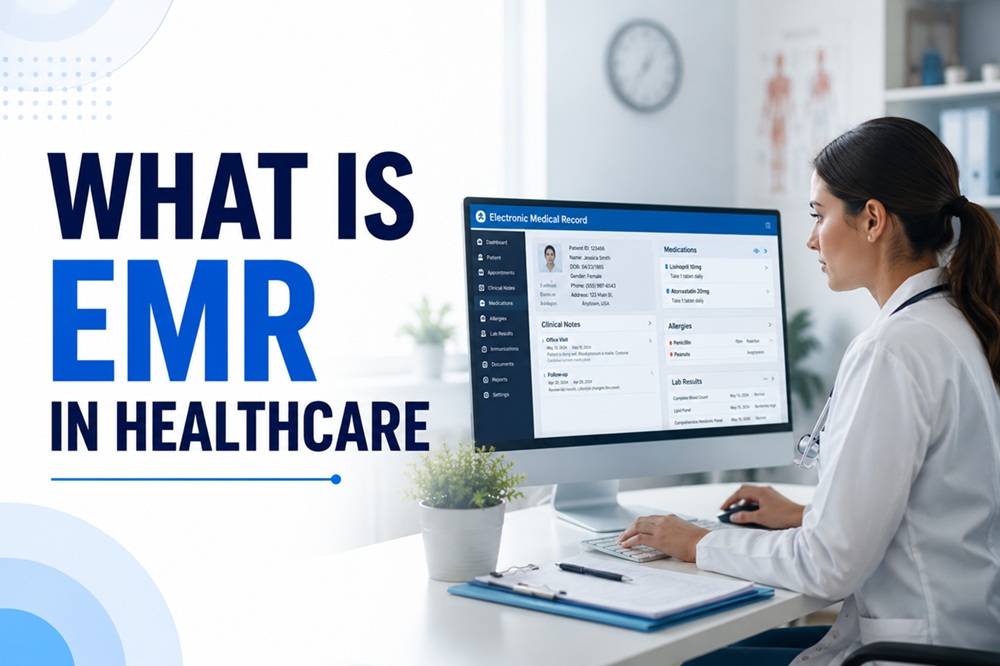

In healthcare, EMR stands for Electronic Medical Record. It is the digital version of the paper chart a doctor’s office once kept, holding your medical and treatment history for a single practice. Instead of a physical folder, your information lives in a secure electronic system that your provider can pull up, update, and organize during your care.
The term is closely tied to another one you have probably seen, EHR, or Electronic Health Record, and the two are often used as if they mean the same thing. They are related but not identical. The simplest way to remember it: an EMR stays mostly within one practice, while an EHR is built to be shared across many providers and follow you wherever you receive care. The rest of this article explains what an EMR contains, what it does well, where it falls short, and how it stacks up against an EHR.
EMR at a Glance
| Detail | Summary |
|---|---|
| What it stands for | Electronic Medical Record |
| What it is | A digital version of your paper chart |
| Scope | Usually one practice or organization |
| Main purpose | Diagnosis, treatment, and recordkeeping |
| Shared across providers? | Not easily |
| Related term | EHR (Electronic Health Record) |
| Who can access it | Your provider, and you, often through a portal |
What Is an EMR, Exactly?
An EMR is a database that captures the information tied to your medical treatment at one healthcare organization. Think of everything that used to be scribbled on a clipboard or filed in a manila folder, now stored digitally and searchable in seconds.
Because it replaces paper, an EMR makes a provider’s day-to-day work faster and safer. Notes are legible, records cannot be physically lost or damaged, and the system can track your health over time. That last point matters more than it sounds, since an EMR can flag when you are due for a preventive screening or follow-up, something a paper chart never did on its own.
What Information Is in an EMR?
An EMR holds the clinical picture a provider builds during your care. The exact contents vary, but most include the following.
| Category | Examples |
|---|---|
| Patient demographics | Name, date of birth, contact details |
| Medical history | Past diagnoses and conditions |
| Medications | Current and past prescriptions |
| Allergies | Drug and other allergies |
| Immunizations | Vaccination records |
| Lab results | Blood work and other tests |
| Imaging | X-rays and radiology results |
| Vital signs | Blood pressure, heart rate, and more |
| Billing | Charges tied to your care |
What’s the Difference Between an EMR and an EHR?
This is the question that trips up most people, so it is worth slowing down on. The difference comes down to one idea: how far the record travels.
An EMR is focused on a single practice. It is excellent at managing your care within that office, but the information does not move easily beyond it. If you switch doctors or see a specialist elsewhere, your EMR often has to be printed out or sent over, which puts you almost back in paper-chart territory.
An EHR is designed to do more. It builds on the same clinical foundation but is meant to be shared securely across different providers, specialists, labs, and hospitals. The record follows the patient through the whole healthcare journey rather than sitting in one place.
| Feature | EMR | EHR |
|---|---|---|
| Scope | One practice | Many providers |
| Built to be shared | No | Yes |
| Follows the patient | No | Yes |
| Main strength | Recordkeeping in one office | Coordinated care across settings |
| Interoperability | Limited | High |
In short, every EHR contains the kind of data an EMR holds, but an EHR adds the ability to connect that data across the places you receive care.
Benefits of EMRs
Even with their limits, EMRs were a major step up from paper, and the advantages are real.
- Records are legible and organized, removing the guesswork of handwritten notes.
- Information cannot be physically lost, misfiled, or destroyed.
- Providers can track changes in your health over time.
- Built-in reminders prompt preventive care like screenings and checkups.
- Data is easier to search, so a provider finds what they need quickly.
These gains improve both efficiency and safety, which is a big reason the healthcare system invested heavily in moving away from paper.
Limitations of EMRs
The main weakness of an EMR is also its defining trait: it lives in a silo. Because it is built for one organization, it does not automatically share data with outside providers.
That gap can fragment your care. If a specialist or hospital needs your history and it sits in another office’s EMR, there can be delays while the record is transferred. Decisions may be made without the full picture, and you might end up repeating tests that were already done elsewhere. This limitation is exactly what pushed the industry toward EHRs and the broader goal of systems that talk to each other.
Can Patients See Their Own EMR?
Yes. You have the right to access your own health information, and these days most people do it through an online patient portal. The portal is the window into the record your provider keeps, letting you view test results, medication lists, visit summaries, and more.
If you have ever logged into a system to check a lab result or message your care team, you have used this access. Many Oregon providers, including large groups like Summit Health, offer portals built on these record systems so patients can see their information any time. The portal does not show you everything a clinician sees, but it puts the essentials in your hands.
EMR, EHR, and PHR
One more term sometimes joins the mix. A PHR, or Personal Health Record, is a record that you create and control yourself, often pulling in information from your providers plus details you add, like over-the-counter medications or readings from a home device.
The quick way to keep them straight: an EMR is the provider’s record in one practice, an EHR is the shareable record across providers, and a PHR is the version you own and manage. All three aim at the same goal of keeping accurate health information accessible to the people who need it.
Why the Terms Get Used Interchangeably
If EMR and EHR have a clear distinction, why do even healthcare professionals swap them so freely? The answer is history. EMR was the original term, coined when practices first digitized their paper charts. As care grew more connected and records needed to travel, EHR emerged as both the standard term and the more clinically useful concept.
Over time, the systems themselves have grown more alike, with many EMR products adding sharing features. That overlap blurred the line, which is why you will hear the words used as if they are the same even though, technically, they are not.
Frequently Asked Questions
What does EMR stand for in healthcare?
EMR stands for Electronic Medical Record, the digital version of a patient’s paper chart kept within a single practice or organization.
Is an EMR the same as an EHR?
Not exactly. An EMR is focused on one practice and does not share easily, while an EHR is designed to be shared across multiple providers and follow the patient.
What information does an EMR contain?
It typically includes demographics, medical history, medications, allergies, immunizations, lab results, imaging, vital signs, and billing details.
Can I access my own EMR?
Yes. You have a right to your health information, and most providers offer an online patient portal where you can view results, medications, and visit summaries.
Why did healthcare switch from paper to EMRs?
EMRs make records legible, organized, and harder to lose, while letting providers track health over time and send automatic reminders for preventive care.
Is an EHR better than an EMR?
For coordinating care across providers, yes, because an EHR shares data widely. For recordkeeping within a single office, an EMR can be perfectly sufficient.