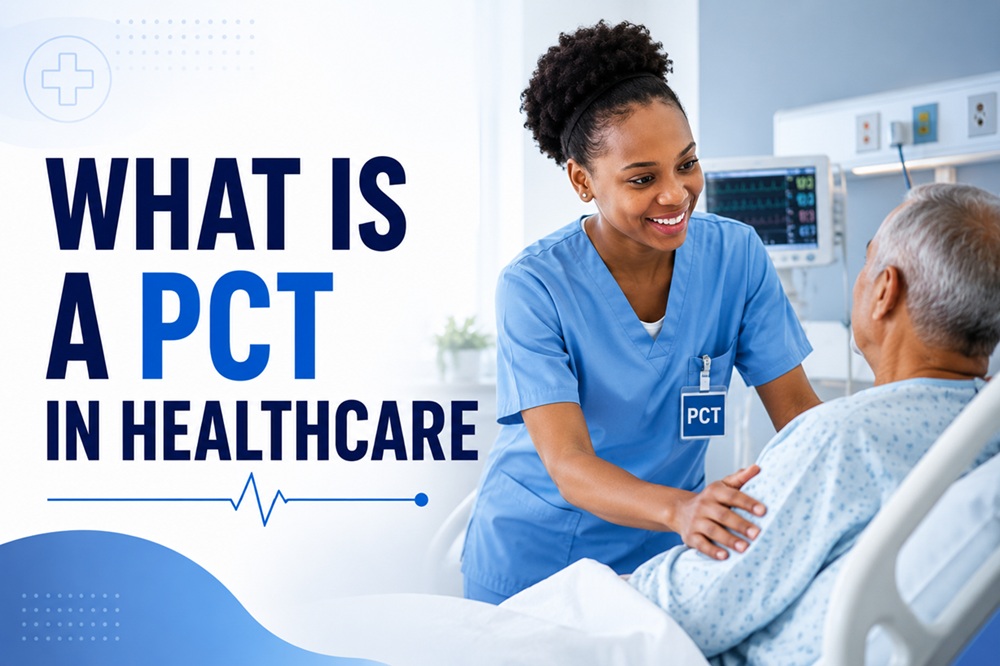

In healthcare, PCT stands for Patient Care Technician. It is a hands-on support role in which the technician works closely with nurses and doctors to care for patients, handling both everyday needs and a set of clinical tasks. A PCT does much of what a nursing assistant does, like helping with bathing, mobility, and vital signs, but with added training that allows them to draw blood, run EKGs, and assist with more technical procedures.
Most PCTs work in hospitals, emergency rooms, dialysis centers, and specialty clinics, where their broader skills help free up nurses for higher-level care. The role is popular as an entry point into healthcare, since it offers real clinical experience and a clear path toward nursing. One quick note on the letters: in a laboratory context, PCT can also refer to procalcitonin, a blood test used to help detect serious bacterial infection. This article focuses on the far more common meaning, the Patient Care Technician.
PCT at a Glance
| Detail | Summary |
|---|---|
| What it stands for | Patient Care Technician |
| What it is | A clinical support role assisting nurses and doctors |
| Key skills | Vital signs, phlebotomy, EKG, basic care |
| Common settings | Hospitals, ERs, dialysis, specialty clinics |
| Training | High school diploma plus a PCT program |
| Certification | CPCT/A, a national credential |
| Compared to | A CNA, with a broader clinical scope |
What Does a PCT Do?
A PCT bridges basic caregiving and clinical support. On one side, they handle the comfort and daily needs that any bedside caregiver does. On the other, they take on procedural tasks that go beyond what a basic nursing assistant typically performs.
| Duty type | Examples |
|---|---|
| Daily living help | Bathing, dressing, feeding, mobility |
| Vital signs | Blood pressure, heart rate, temperature |
| Phlebotomy | Drawing blood and collecting specimens |
| EKGs | Operating electrocardiogram equipment |
| Glucose monitoring | Checking and recording blood sugar |
| Procedural assist | Catheter care, removing stitches or staples |
| Monitoring | Watching patients and reporting changes |
Because PCTs interact with people during vulnerable moments, the job leans on patience, compassion, and steady communication, plus the physical stamina to stay on their feet through long shifts.
Where Do PCTs Work?
Setting is one of the biggest practical differences between a PCT and other entry-level roles. Hospitals are the most common workplace, since their patients have greater medical needs and benefit from a technician who can handle routine clinical tasks.
Beyond the hospital floor, PCTs are in demand in emergency departments and specialty clinics. Dialysis centers in particular hire many PCTs, since the technical skills fit the needs of kidney care. You will still find PCTs in nursing facilities and retirement communities, but their training opens doors to more acute and specialized environments.
What’s the Difference Between a PCT and a CNA?
This is the most common question, because the two roles look almost identical from the outside. Both assist nurses, both help with daily care, and both are accessible without years of schooling. The difference is scope and credentialing.
| Feature | PCT | CNA |
|---|---|---|
| Clinical scope | Broader, includes phlebotomy and EKG | Focused on daily care and vitals |
| Certification | National (CPCT/A) | State-issued |
| Transferable | Works across states | Usually tied to one state |
| Common setting | Hospitals and specialty care | Long-term and home care |
| Pay | Typically slightly higher | Slightly lower on average |
A CNA is a state-licensed nursing assistant centered on activities of daily living. A PCT generally does everything a CNA does and adds procedural skills like drawing blood and running EKGs. In fact, many states expect you to hold a CNA credential first, then build PCT skills on top of it. Some states even use the terms interchangeably, so the exact scope can depend on your state and employer.
What Training and Certification Does a PCT Need?
Becoming a PCT is one of the faster routes into clinical healthcare. The baseline is a high school diploma or equivalent, plus passing a background check, followed by a PCT training program.
These programs are often around eight weeks and include a clinical externship for hands-on hours, frequently in the range of 80 to 160 hours. Many programs build on CNA-level skills, which is why a CNA certification is a common prerequisite or is bundled into the training. The training covers the technical pieces that set the role apart, including phlebotomy, EKGs, and electronic health record basics.
The standard credential is the Certified Patient Care Technician/Assistant, or CPCT/A, offered through the National Healthcareer Association. It is technically voluntary, but the vast majority of employers prefer or require it, and unlike a state CNA license, the national certification is recognized across the country without retraining.
PCT Salary and Job Outlook
Pay varies by location, employer, and experience, but PCTs generally earn somewhere around $38,000 to $40,000 a year on average, often a bit more than CNAs thanks to the added clinical scope. Hospital settings tend to sit at the higher end, and night or weekend shifts can raise earnings further.
The outlook is steady, driven by an aging population and ongoing demand for hands-on care. Because the role builds real clinical skills, many people use it as a stepping stone toward becoming a licensed practical nurse or registered nurse.
PCT vs PCA
These two abbreviations cause real confusion, since they differ by a single letter and overlap in everyday care. The simplest distinction is in the clinical depth.
A PCA, or Personal Care Assistant, usually focuses on non-medical support like helping with daily living tasks, often in a home setting. A PCT, or Patient Care Technician, takes on more clinical responsibility, including procedures like phlebotomy and EKGs, typically in a hospital. That said, some hospitals use the title Patient Care Assistant for a role similar to a technician, so the duties behind any given title can vary by employer. When in doubt, read the specific job description.
Is a PCT a Good Career Choice?
For people who want into healthcare quickly and enjoy hands-on clinical work, the PCT path has real appeal. It offers more procedural variety than a basic nursing assistant role, a nationally transferable credential, and a natural ladder toward nursing.
It suits someone who stays calm under pressure, is comfortable around blood and bodily fluids, and prefers being on their feet rather than behind a desk. If your goal is long-term care or home health with a focus on companionship, a CNA path may fit better. If you are aiming at hospital work, dialysis, or nursing school down the line, a PCT is often the stronger starting point.
Frequently Asked Questions
What does PCT stand for in healthcare?
It stands for Patient Care Technician, a support role that assists nurses and doctors with hands-on care plus clinical tasks like phlebotomy and EKGs. In lab settings, PCT can also mean procalcitonin, a blood test.
Is a PCT the same as a CNA?
No. A PCT performs the duties of a CNA plus a broader range of clinical tasks, holds a national certification, and more often works in hospitals.
What does a patient care technician do all day?
They help patients with daily needs, take vital signs, draw blood, run EKGs, monitor patients, and report changes to the nursing team.
How long does it take to become a PCT?
A PCT program often takes around eight weeks plus a clinical externship. Many programs build on or require a CNA credential first.
Do PCTs need to be certified?
Certification is technically voluntary, but most employers prefer or require the national CPCT/A credential, which works across states.
How much does a PCT make?
On average, somewhere around $38,000 to $40,000 a year, typically a bit more than a CNA, with higher pay in hospitals and for night or weekend shifts.